The core of the sun: It's magic

The core of sun The core of the Sun is considered to extend from the center to about 20–25% of the solar radius. It has a150 g/cm3 (about 150 times the density of water) and a temperature of close to 15.7 million kelvin (K).

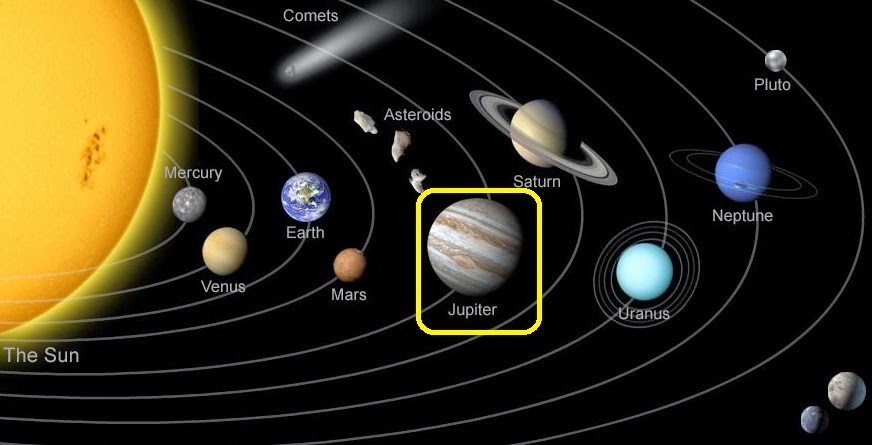
Jupiter: The 5th palnet

upiter is the fifth planet from the Sun and the largest planet in the Solar System. It is a gas giant with mass one-thousandth of that of the Sun but is two and a half times the mass of all the other planets in the Solar System combined. Jupiter is classified as a gas giant along with Saturn, Uranus and Neptune.

The Earth ... Our fantastic planet

Earth, also known as the world, Terra, or Gaia, is the third planet from the Sun, the densest planet in the Solar System, the largest of the Solar System's four terrestrial planets

The magic Hubble Space Telescope

The Hubble Space Telescope (HST) is a space telescope that was launched into low Earth orbit in 1990near ultraviolet, visible, and near infrared spectra. The telescope is named after the astronomer Edwin Hubble. and remains in operation.

NASA Telescopes Uncover Early Construction of Giant Galaxy

Astronomers have for the first time caught a glimpse of the earliest stages of massive galaxy construction. The building site

Showing posts with label Nasa. Show all posts

Wednesday, September 17, 2014

Galaxy Collision (Video)


Two spiral galaxies undergo a protracted crash lasting two billion years, eventually merging into a single
elliptical galaxy. Credit: NCSA/NASA/B. Robertson (Caltech) and L. Hernquist (Harvard Univ.)


Video from youtube

NASA’s Chandra X-ray Observatory Finds Planet That Makes Star Act Deceptively Old


A planet may be causing the star it orbits to act much older than it actually is, according to new data from Chandra X-ray Observatory. This discovery shows how a massive planet can affect the behavior of its parent star.
NASA’s
The star, WASP-18, and its planet, WASP-18b, are located about 330 light-years from Earth. WASP-18b has a mass about 10 times that of Jupiter and completes one orbit around its star in less than 23 hours, placing WASP-18b in the “hot Jupiter” category of exoplanets, or planets outside our solar system.
WASP-18b is the first known example of an orbiting planet that has apparently caused its star, which is roughly the mass of our sun, to display traits of an older star.
“WASP-18b is an extreme exoplanet,” said Ignazio Pillitteri of the Istituto Nazionale di Astrofisica (INAF)-Osservatorio Astronomico di Palermo in Italy, who led the study. “It is one of the most massive hot Jupiters known and one of the closest to its host star, and these characteristics lead to unexpected behavior. This planet is causing its host star to act old before its time.”
Pillitteri’s team determined WASP-18 is between 500 million and 2 billion years old, based on theoretical models and other data. While this may sound old, it is considered young by astronomical standards. By comparison, our sun is about 5 billion years old and thought to be about halfway through its lifetime.
Younger stars tend to be more active, exhibiting stronger magnetic fields, larger flares, and more intense X-ray emission than their older counterparts. Magnetic activity, flaring, and X-ray emission are linked to the star’s rotation, which generally declines with age. However, when astronomers took a long look with Chandra at WASP-18 they didn’t detect any X-rays. Using established relations between the magnetic activity and X-ray emission of stars, as well as its actual age, researchers determined WASP-18 is about 100 times less active than it should be.
“We think the planet is aging the star by wreaking havoc on its innards,” said co-author Scott Wolk of the Harvard-Smithsonian Center for Astrophysics in Cambridge, Massachusetts.
The researchers argue that tidal forces created by the gravitational pull of the massive planet – similar to those the moon has on Earth’s tides, but on a much larger scale – may have disrupted the magnetic field of the star.
The strength of the magnetic field depends on the amount of convection in the star, or how intensely hot gas stirs the interior of the star.

Link

Newly Found Ring System Similar To Saturn


The scientists, led by Assistant Professor of Physics and Astronomy Eric Mamajek of Rochester and the
Cerro Tololo Inter-American Observatory, used data from the international SuperWASP (Wide Angle Search for Planets) and All Sky Automated Survey (ASAS) project to study the light curves of young Sun-like stars in the Scorpius-Centaurus association–the nearest region of recent massive star formation to the Sun.
The basic concept of the research is straightforward. Imagine yourself sitting in a park on a sunny afternoon and a softball passes between you and the sun. The intensity of light from the sun would appear to weaken for just a moment. Then a bird then flies by, causing the intensity of the sunlight to again weaken–more or less than it did for the baseball, depending on the size of the bird and how long it took to pass. That’s the principle that allowed the researchers to discover a cosmic ring system.
A light curve is a graph of light intensity over time, and one star in particular showed dramatic changes during a 54 day period in early 2007. University of Rochester graduate student Mark Pecaut and Mamajek discovered the unusual eclipse in December 2010. “When I first saw the light curve, I knew we had found a very weird and unique object. After we ruled out the eclipse being due to a spherical star or a circumstellar disk passing in front of the star, I realized that the only plausible explanation was some sort of dust ring system orbiting a smaller companion–basically a ‘Saturn on steroids,’” said Mamajek.
If a spherical object merely passed in front of the star, the intensity of the light would gradually dim and reach a low point before gradually increasing. That was not the case with the star identified as 1SWASP J140747.93-394542.6. The Rochester team discovered a long, deep, and complex eclipse event with significant on-and-off dimming. At the deepest parts of the eclipse, at least 95% of the light from the star was being blocked by dust.
The shape of the light curve was very similar to that of a well-researched star (EE Cephei), suggesting similar traits in the companion objects. However EE Cephei differs in that it appears to be a thick protoplanetary disk transiting–or passing–in front a massive, hot star. “We suspect this new star is being eclipsed by a low-mass object with an orbiting disk that has multiple thin rings of dust debris,” said Mamajek. The star is similar in mass to the sun, but is much younger – about 16 million years old or 1/300th the age of the solar system – and it lies about 420 light years away.


Read more

NASA Selects Boeing and SpaceX for Commercial Crew Contracts


Under the Commercial Crew Transportation Capability (CCtCap) contracts, the two companies will
continue development of spacecraft capable of transporting NASA astronauts to and from the International Space Station as early as 2017, ending the agency’s dependence on Russian Soyuz spacecraft.
The contracts cover the development and certification of the spacecraft, including at least one test flight with both NASA and commercial crewmembers on board. The awards also fund between two and six operational flights to the ISS, each carrying four astronauts, once NASA certifies each company’s vehicle. Unlike previous phases of NASA’s commercial crew program, which used funded Space Act Agreements that provided greater flexibility, the CCtCap awards are fixed-price contracts.
“This was not an easy choice,” NASA Administrator Charles Bolden said at the Sept. 16 announcement at the Kennedy Space Center, “but this is the best choice for NASA and the nation.”
Boeing will receive $4.2 billion to build the CST-100 spacecraft, which it has been working on since the initial phases of NASA’s commercial crew program in 2010. The spacecraft will be launched on a United Launch Alliance Atlas 5 rocket.
“Boeing has been part of every American human space flight program, and we’re honored that NASA has chosen us to continue that legacy,” John Elbon, Boeing vice president and general manager for space exploration said in a company press release. “The CST-100 offers NASA the most cost-effective, safe and innovative solution to U.S.-based access to low-Earth orbit.”
SpaceX will receive $2.6 billion to build its Dragon V2 spacecraft, an upgraded version of the Dragon spacecraft currently used to transport cargo to and from the ISS. Dragon V2 will launch on the company’s Falcon 9 v1.1 rocket. 


Tuesday, September 16, 2014

NASA Research Gives Guideline for Future Alien Life Search

Astronomers searching the atmospheres of alien worlds for gases that might be produced by life can't rely on
the detection of just one type, such as oxygen, ozone, or methane, because in some cases these gases can be produced non-biologically, according to extensive simulations by researchers in the NASA Astrobiology Institute’s Virtual Planetary Laboratory. 

The researchers carefully simulated the atmospheric chemistry of alien worlds devoid of life thousands of times over a period of more than four years, varying the atmospheric compositions and star types. "When we ran these calculations, we found that in some cases, there was a significant amount of ozone that built up in the atmosphere, despite there not being any oxygen flowing into the atmosphere," said Shawn Domagal-Goldman of NASA's Goddard Space Flight Center in Greenbelt, Maryland. "This has important implications for our future plans to look for life beyond Earth."
Methane is a carbon atom bound to four hydrogen atoms. On Earth, much of it is produced biologically (flatulent cows are a classic example), but it can also be made inorganically; for example, volcanoes at the bottom of the ocean can release the gas after it is produced by reactions of rocks with seawater.
Ozone and oxygen were previously thought to be stronger biosignatures on their own. Ozone is three atoms of oxygen bound together. On Earth, it is produced when molecular oxygen (two oxygen atoms) and atomic oxygen (a single oxygen atom) combine, after the atomic oxygen is created by other reactions powered by sunlight or lightning. Life is the dominant source of the molecular oxygen on our planet, as the gas is produced by photosynthesis in plants and microscopic, single-cell organisms. Because life dominates the production of oxygen, and oxygen is needed for ozone, both gases were thought to be relatively strong biosignatures. But this study demonstrated that both molecular oxygen and ozone can be made without life when ultraviolet light breaks apart carbon dioxide (a carbon atom bound to two oxygen atoms). Their research suggests this non-biological process could create enough ozone for it to be detectable across space, so the detection of ozone by itself would not be a definitive sign of life.
"However, our research strengthens the argument that methane and oxygen together, or methane and ozone together, are still strong signatures of life," said Domagal-Goldman. "We tried really, really hard to make false-positive signals for life, and we did find some, but only for oxygen, ozone, or methane by themselves." Domagal-Goldman and Antígona Segura from the Universidad Nacional Autónoma de México in Mexico City are lead authors of a paper about this research, along with astronomer Victoria Meadows, geologist Mark Claire, and Tyler Robison, an expert on what Earth would look like as an extrasolar planet. The paper appeared in the Astrophysical Journal Sept. 10, and is available online.
Methane and oxygen molecules together are a reliable sign of biological activity because methane doesn't last long in an atmosphere containing oxygen-bearing molecules. "It's like college students and pizza," says Domagal-Goldman. "If you see pizza in a room, and there are also college students in that room, chances are the pizza was freshly delivered, because the students will quickly eat the pizza. The same goes for methane and oxygen. If both are seen together in an atmosphere, the methane was freshly delivered because the oxygen will be part of a network of reactions that will consume the methane. You know the methane is being replenished. The best way to replenish methane in the presence of oxygen is with life. The opposite is true, as well. In order to keep the oxygen around in an atmosphere that has a lot of methane, you have to replenish the oxygen, and the best way to do that is with life."
Scientists have used computer models to simulate the atmospheric chemistry on planets beyond our solar system (exoplanets) before, and the team used a similar model in its research. However, the researchers also developed a program to automatically compute the calculations thousands of times, so they could see the results with a wider range of atmospheric compositions and star types.
In doing these simulations, the team made sure they balanced the reactions that could put oxygen molecules in the atmosphere with the reactions that might remove them from the atmosphere. For example, oxygen can react with iron on the surface of a planet to make iron oxides; this is what gives most red rocks their color. A similar process has colored the dust on Mars, giving the Red Planet its distinctive hue. Calculating the appearance of a balanced atmosphere is important because this balance would allow the atmosphere to persist for geological time scales. Given that planetary lifetimes are measured in billions of years, it's unlikely astronomers will happen by chance to be observing a planet during a temporary surge of oxygen or methane lasting just thousands or even millions of years.


Learn more